The seismic shift toward distributed work environments has permanently recalibrated the fundamental dynamics of workforce management. In the co-located office, oversight was organic—a byproduct of shared physical space. The transition to remote models, however, necessitated the rapid adoption of digital tools to bridge the visibility gap, leading to the proliferation of employee monitoring software. Automated screenshotting, a key feature in many of these platforms, has emerged as one of the most contentious tools, creating a profound tension between managerial demand for objective accountability and employee need for professional autonomy.
This comprehensive analysis moves beyond surface-level debates to explore the intricate technological, legal, and psychological ramifications of automated visual monitoring, aiming to provide a structured framework for organizations navigating this complex ethical and operational landscape.
How Data-Driven Teams Scale Faster
I. Deconstructing Automated Screenshot Monitoring
Automated screenshot monitoring operates by integrating specialized software directly into an employee's operating system. The mechanics are precise and variable:
- Interval-Based Capture: Images are taken at fixed, short intervals (e.g., every 5 to 10 minutes), creating a sequential visual timeline of the workday.
- Activity-Triggered Capture: More advanced systems initiate captures based on specific user actions, such as detecting keyboard inactivity, logging into a work application, or switching between project files.
- Metadata Harvesting: Crucially, these systems rarely capture only images. They simultaneously log rich metadata, including active application names, URL history, keystroke counts, mouse movements, and idle time. This data aggregation transforms simple visual evidence into a complex, quantitative record of professional behavior.
The data is typically encrypted and uploaded to a centralized, secure dashboard. For management, this provides a granular, objective record designed to replace the subjective judgment inherent in remote supervision.
II. The Rationale for Adoption: Managerial Imperatives
The decision to implement automated screenshotting is generally driven by four core organizational needs, rooted in accountability and data-driven optimization:
A. Establishing Objective Accountability and Verification
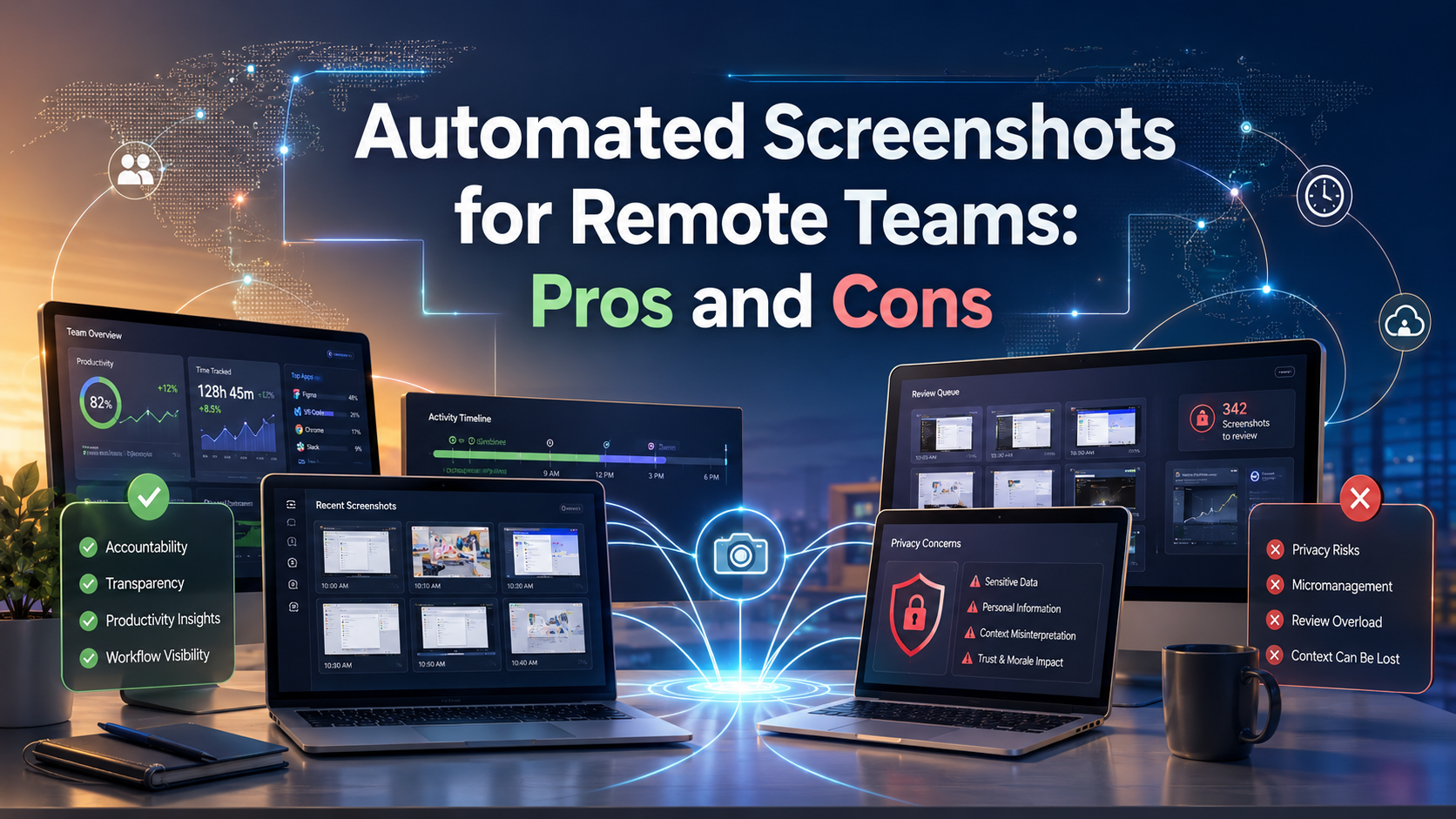
In an environment where outputs are difficult to quantify, visual records offer concrete proof of engagement. This moves the conversation beyond mere trust and provides verifiable artifacts of work progression. Knowing that activity is being logged acts as a powerful deterrent against "time theft" and increases focus on core tasks, establishing a measurable baseline for expected remote performance.
B. Enhancing Precision in Client and Project Billing
For service-based businesses, such as legal firms, design agencies, and consultancies, accurate client invoicing is a regulatory and ethical requirement. Automated screenshots act as a crucial evidentiary layer supporting timesheets. They ensure clients are billed only for demonstrable, relevant activity, safeguarding the firm against disputes and reinforcing a standard of financial transparency that builds trust with external stakeholders.
C. Fueling Operational Optimization through Data
Beyond individual oversight, the aggregated data derived from these tools offers substantial value for industrial and organizational psychology. By analyzing patterns of screen activity across teams and projects, organizations can leverage powerful Employee Productivity Analytics. This moves the function of the software from a punitive tool to an optimization engine. Managers can identify systemic bottlenecks (e.g., spending excessive time on non-work applications, battling slow internal tools, or suffering from "context switching" fatigue) and implement targeted process improvements, resource reallocation, or essential training.
D. Supporting Fair and Detailed Performance Review
Performance evaluations in remote settings often rely on subjective reports or sparse, end-of-quarter metrics. Screenshot evidence provides managers with a continuous, objective portfolio of an employee's workflow, allowing for the recognition of consistent effort, the identification of genuine blockages, and the offering of tailored support, thereby making performance discussions more factual and less prone to bias.
III. The Detriments: Cultural and Psychological Costs
Despite the clear operational benefits, the implementation of automated monitoring carries significant risks, primarily affecting employee psychology, corporate culture, and legal standing.
A. The Erosion of Trust and Cultivating Presenteeism
The most immediate and severe consequence of visual surveillance is the breakdown of the foundational employer-employee trust relationship. When monitoring is perceived as "spying" rather than support, it sends a clear message of distrust. This can breed resentment, leading to a dysfunctional culture where employees prioritize looking busy over genuine creative output—a phenomenon known as digital presenteeism. This "fake work" diverts energy from meaningful contribution and ultimately degrades the quality and efficiency of the overall workforce.
B. The Psychological Burden of Hyper-Visibility
The constant awareness of being visually tracked creates a mental tax, often termed hyper-visibility stress. This continuous cognitive load interferes directly with the state of "deep work"—a necessary condition for complex problem-solving and innovation. For highly specialized roles, such as software development or data science, where long periods of concentrated, non-typing thought are essential, the pressure of the screenshot timer can be profoundly counterproductive. Many technical teams, recognizing this friction, prefer specialized metric systems like Developer Time Tracking Software that quantify contributions via code commits, pull requests, and deployment cycles, which are better proxies for complex output than visual snapshots.
C. Heightened Privacy and Ethical Exposure
The blurred lines of the "work-from-home" setup make privacy violations nearly inevitable. An automated capture might record sensitive personal information, such as login credentials, bank statements, or private medical correspondence. This risk places a heavy ethical and legal burden on the organization, especially when considering the employee's right to digital self-determination.
D. Navigating Complex Legal and Regulatory Frameworks
In jurisdictions with rigorous data protection legislation (e.g., the European Union's GDPR, the California Consumer Privacy Act/CCPA), intensive visual monitoring must meet strict standards of necessity and proportionality. Organizations must demonstrate a lawful basis, transparently inform employees, and provide rights of access and rectification. Failure to comply has led to significant fines and legal challenges, proving that the technical solution must be governed by a robust legal strategy.
IV. Best Practices: An Ethical Framework for Implementation
To harness the data utility of screenshot monitoring while safeguarding team morale and dignity, organizations must adhere to a strict ethical and communication framework:
- Mandatory Radical Transparency: Define and communicate a comprehensive policy that specifies what is tracked (screenshots, keystrokes, URLs), when it is tracked (only during logged work hours), why it is tracked (e.g., billing, not policing), and who has access to the data (e.g., immediate manager only, secured access).
- Ensure Proportionality and Minimization: Only track the minimum data required to achieve the stated business objective. Utilize blurring technology to mask sensitive personal text within screenshots, protecting privacy while confirming application use.
- Empower Employee Self-Audit: Grant employees full, real-time access to their own activity logs. Crucially, provide a documented mechanism for employees to flag or delete inadvertent personal captures before they are submitted for management review, thereby establishing a collaborative trust model.
- Shift Focus to Outcomes, Not Inputs: Train managers to use the data diagnostically—to identify and remove systemic organizational friction (e.g., excessive meeting load) rather than punitively policing individual minutes. The data should support the employee's success, not merely document their failures.
- Pilot and Review: Implement the system initially with a small, volunteer pilot group, gathering and acting upon feedback before any company-wide rollout. This iterative process ensures the final policy aligns with cultural acceptance.
V. Conclusion: The Middle Path to Effective Remote Oversight
Automated screenshotting remains a powerful, yet intrinsically polarizing, instrument in the remote work toolkit. Its utility for ensuring objective billing, improving operational efficiency, and grounding performance reviews in data is undeniable. However, these benefits are irrevocably tied to the cultural cost of perceived surveillance.
The most resilient and high-performing remote organizations will be those that successfully navigate this tension by adopting a "middle path." This involves leveraging the data-driven insights of monitoring software to support their workforce (e.g., protecting a developer's focus time with objective data) while simultaneously enforcing policies of radical transparency and professional respect. When managed ethically and integrated into a culture that values autonomy, automated monitoring shifts from being an invasive surveillance tool to a protective mechanism for focused, efficient work. The future of remote management is not about more tracking, but about smarter tracking governed by stronger ethics.